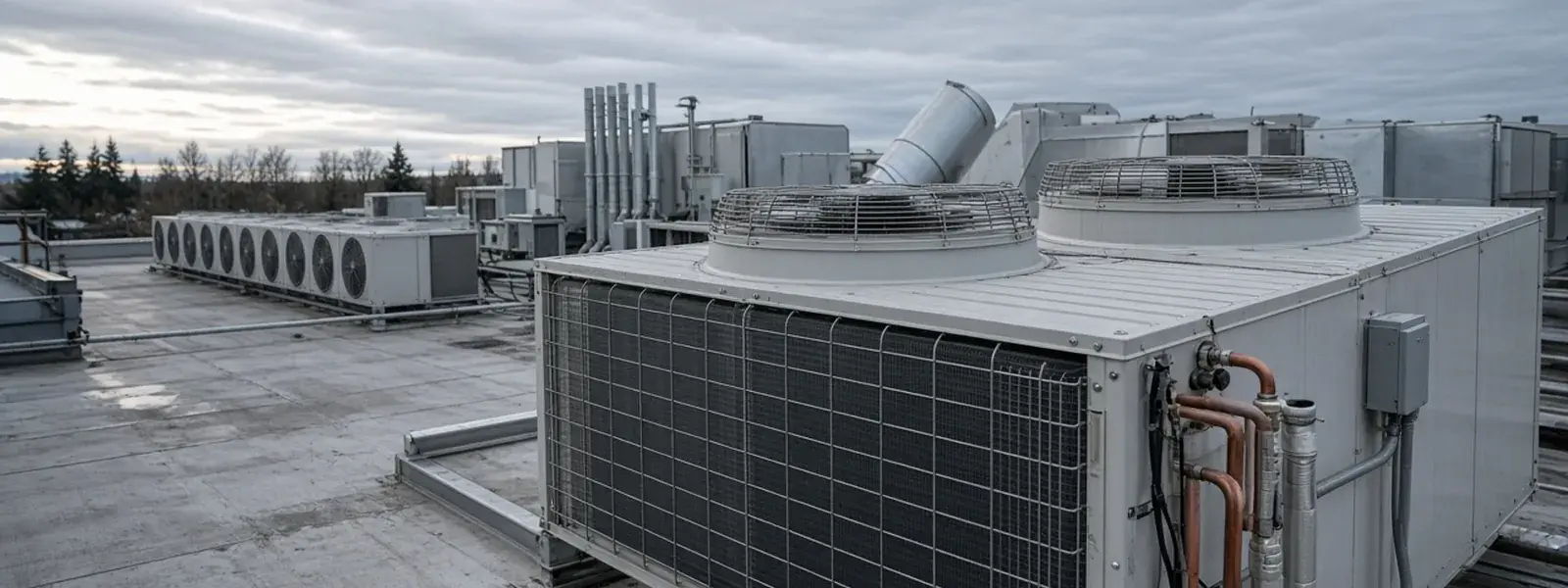
If the building is warm and the rooftop or condenser is running, you don't have a thermostat problem. You have a circuit that can't reject heat, a coil that can't absorb it, or a fan that's not moving air. Langley Quality Commercial HVAC repairs commercial air conditioning on packaged units and split condensers by reading superheat, subcooling, and head pressure, not by adding gas until the gauges look busy. A Fraser Highway retail suite that won't hold 23 °C in July is usually a dirty condenser, a failed outdoor fan, a leak, or a TXV that has quit. We find which one before we talk about a compressor.
Langley cooling season is short and humid. That means algae in pans, alder fluff on coils, and economizers that fight the compressor on shoulder days. We check the outdoor air damper on every no-cool call because a stuck-open economizer on a 28 °C afternoon won't save you, and a stuck-shut damper on a 16 °C day wastes the circuit.
Split condensers behind offices get the same gauge work, plus a look at the line set and the indoor coil that nobody has seen since the last tenant improvement.
What is on the ticket
- Cooling call verification at the stat, occupancy sensor, and Y circuit
- Condenser fan motor, capacitor, and head pressure against outdoor air
- Superheat and subcooling on each DX circuit
- TXV bulb mount, orifice, and filter drier pressure drop
- Leak search on coils, rotolock fittings, and vibration points
- Evaporator coil loading, approach, and condensate drain
- Low-ambient controls and fan cycling if the space runs year-round
- Economizer damper position during the cool call
- Blower CFM inferred from external static pressure and the fan table
- Compressor amp draw, discharge temperature, and contactor condition
When this call shows up
The unit runs and the suite stays warm
Air is moving, the outdoor fan may even be spinning, and the room won't drop. That's charge, airflow, or a failed circuit, and gauges settle it.
The outdoor fan is dead or cycling wildly
Head pressure climbs, the high-pressure switch opens, and the compressor locks out. Replacing the scroll without spinning the fan is a wasted part.
Ice on the suction line or the indoor coil
Low charge, a plugged filter, or a blower that can't overcome ESP will freeze a DX coil even in a Langley July if the wet bulb is right.
One circuit cools and the other is silent
Dual-circuit packaged units hide a dead scroll for weeks. The suite feels 'a bit warm' until a heat wave. We gauge both circuits.
The space is a server room or a shop that must stay cool in April
Low-ambient controls, fan cycling, and a working economizer matter as much as mid-summer charge. We treat those rooms as year-round DX, not seasonal AC.
How we work the job
Prove the cool call is real
We check setpoint, occupancy, and 24 volts on Y at the unit. A BAS that dropped a point or a stat in heat mode wastes an hour on a healthy condenser.
Read head pressure and outdoor fan performance
Amp draw, capacitor, and coil cleanliness come before the compressor conversation. High head from a packed condenser looks like a bad scroll from the suite.
Take superheat and subcooling on each circuit
High superheat with low subcooling is a starve or a leak. Low superheat with high subcooling is a flood or a stuck TXV. Those numbers decide the next part.
Inspect the indoor coil, drain, and ESP
A loaded evaporator, a dry trap, or a blower off the fan table will keep the room warm with a full charge. We measure, we don't guess from the supply-air feel.
Fix the fault and confirm the approach
After the repair we want stable head, sensible superheat, and a drain that actually moves condensate. You get the numbers and the failed part on the ticket.
Why this shop for commercial ac repair
We don't 'top up' a leaking circuit and leave
Charge without a leak path is a short visit and a repeat call. We search the coil, the rotolocks, and the vibration points.
Dual-circuit units get both circuits on the gauges
A half-dead 20-ton will limp through June and fail in a heat wave. We catch the quiet circuit while we're already on the roof.
Economizer position is part of AC repair
A damper fighting the compressor, or dumping hot outdoor air, will fool a night tech into adding refrigerant. We stroke it every time.
Fraser Highway retail is a specific roof type
Short curbs, street dust, and tenants who notice at noon. We work those cabinets as packaged DX, not as a house air conditioner on a stick.
Year-round cool rooms get low-ambient attention
If the space can't float with the weather, fan cycling and a working outdoor coil matter in April as much as in August.
The Langley detail
Fraser Highway retail is where a lot of Langley commercial AC repair actually happens. The units are packaged, the roofs are low, and the tenants notice the moment the sales floor goes past comfort. Street dust and cottonwood load the condenser faster than a warehouse coil sitting above a gravel yard. High head is the usual first finding. A condenser fan that has lost a capacitor, a coil you can't see through, or a hail guard stuffed with bags will trip the high-pressure switch and make everyone talk about a compressor. We clean, we spin the fan, and we read head pressure against outdoor air before that conversation starts.
Superheat and subcooling are the only honest language on a DX circuit. On a TXV system we want the bulb tight, insulated, and on the correct suction position. A bulb that has been hanging in the cabinet air since 2004 will hunt and flood. On a piston or orifice unit the charge window is tighter, and a 'top up' from the last visit is often why the compressor is washing out. We recover, weigh, and compare to the data plate, then look for oil at the coil U-bends and the rotolock joints. If it is a leak, the leak is the job. The kilogram of refrigerant isn't.
Indoor airflow is the half of AC repair that happens under the roof, not on it. External static pressure that's already above the blower table means the coil never sees design CFM. Filters stuffed in a 1-inch rack, a crushed return, or a tenant who taped cardboard over a grille will ice a coil and look like a charge problem. We measure ESP, look at the fan table on the data plate, and open the evaporator. Condensate has to leave too. A dry trap on a wet Fraser Valley week will slurp air and stall drainage, then the overflow switch kills Y and everyone thinks the AC died.
Shoulder season in the Fraser Valley is when economizers earn their keep and when they cause the noisiest callbacks. A working dry-bulb or enthalpy control should take free cooling when the outdoor air can actually help. When it can't, the damper needs to sit at minimum outdoor air so the compressor isn't fighting a flood of warm, wet air. We don't leave an economizer pinned open because someone wanted 'fresh air' in a heat wave. We set it, we record the minimum, and we tell you if the actuator is dead and the blades are a monument.
Langley Quality Commercial HVAC keeps commercial AC repair on the gauges and the fan table, not on a guess from the supply-air feel. If a Fraser Highway shop or a warehouse floor is warm, call with the suite, how we get to the unit, and whether one circuit or the whole cabinet is quiet. We will tell you if this is a condenser fan, a leak, a TXV, or a scroll that's actually done, and we will leave the superheat and subcooling on the ticket.
Towns we cover
Work is dispatched from Langley across the Fraser Valley. See every municipality on the where we work page.