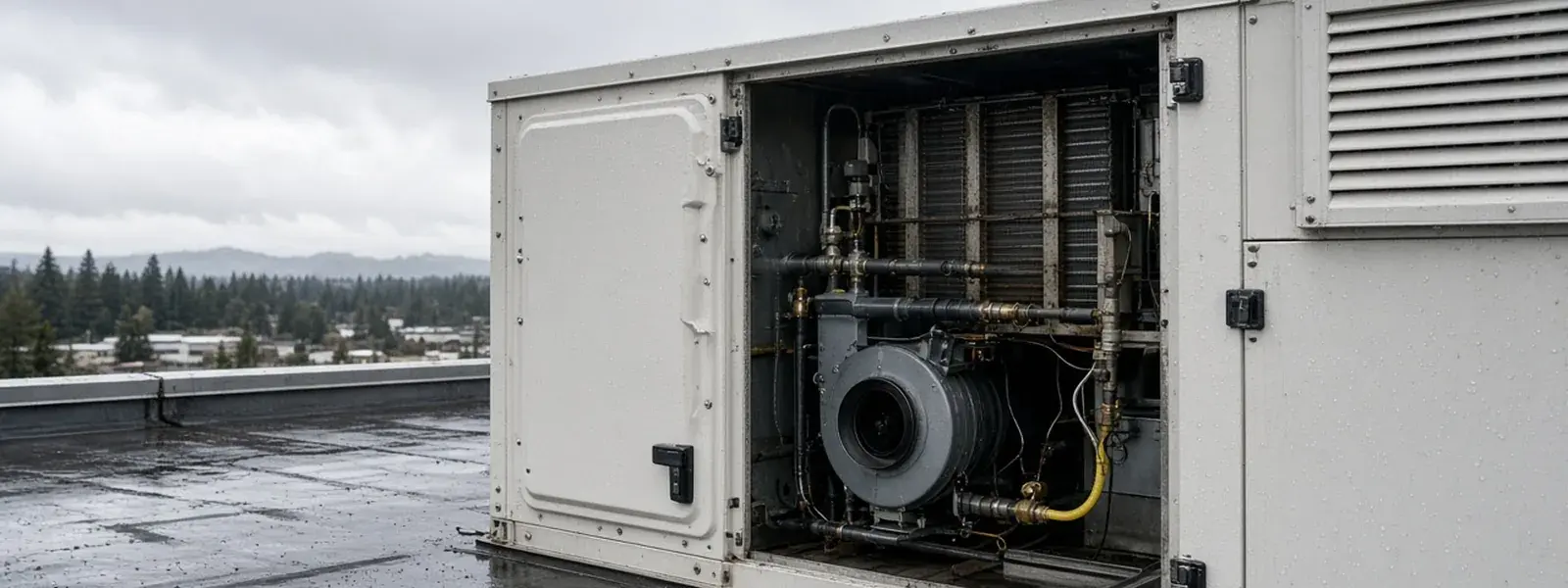
A warehouse or shop that won't heat is often a gas rooftop that failed to light, an indoor furnace or unit heater that won't prove draft, or a heat exchanger that has had enough winters. Langley Quality Commercial HVAC repairs commercial heating by proving the gas train, the inducer, and the flame signal before anyone orders a valve. Wet Fraser Valley winters load pressure-switch tubing with condensate and rust burner trays that were dry in August. We treat that weather as part of the fault, not as bad luck.
Gas work on these cabinets sits under Technical Safety BC rules. Manifold pressure, valve replacement, and heat exchanger decisions are not casual parts swaps. We check combustion air, rollout, and the limit circuit the way a gasfitter is supposed to, then we tell you if the exchanger is stained, cracked, or still serviceable.
If the unit is a heat pump instead of gas, we still start with the call and the defrost board. A lot of Langley commercial heat is still gas, either in a packaged box or hanging over a warehouse aisle.
What is on the ticket
- Heat call verification on W, staged heat, and occupancy
- Inducer motor, wheel, and pressure-switch tubing
- Hot surface igniter or spark, flame sensor microamps, and ground
- Gas valve, manifold pressure, and burner tray condition
- Heat exchanger visual for cracks, rust-through, and rollout marks
- Rollout switches, high limit, and vent pressure switch
- Technical Safety BC gas-safe checks on valve and pipe work
- Blower proving, fan-on delay, and external static pressure in heat
- Condensate from high-efficiency heat, trap, and freeze risk
- Cabinet and vestibule rust after a wet season
When this call shows up
The unit clicks, the inducer runs, and there is no flame
Igniter, flame sensor, or a valve that won't open. We measure flame signal and manifold pressure instead of replacing parts in a circle.
Heat starts, then the board locks out
A wet pressure-switch hose, a blocked inducer, or a dirty burner will drop the prove and store a flame-failure code. Resetting it overnight isn't a repair.
You smell gas or see rollout at the burner access
That's a stop-and-inspect call. Cracked heat exchanger, blocked exchanger, or a cabinet that can't draft. We don't keep firing it to 'see if it settles.'
The warehouse is 8 °C and the unit says it is running
A slipping belt, a fan that never comes on after the heat delay, or a staged unit stuck on low fire will run without heating the volume.
One RTU heats and the next curb is silent after a cold snap
Aging inducers and igniters fail in clusters on 1990s cabinets. We can walk the row and note which units are one winter from the same fault.
How we work the job
Confirm W and watch the trial for ignition
We want 24 volts on heat, a clean inducer start, and a pressure switch that actually closes. A lot of 'no heat' is a hose full of water or an inducer that has lost its wheel.
Measure flame signal and manifold pressure
Microamps on the flame sensor and inches of water column at the manifold tell us if the burner is lighting rich, lean, or not at all. We don't guess from the colour through a dirty window.
Inspect the heat exchanger and the rollout path
Cracks, rust holes, and soot at the vestibule end the repair path. Staining gets documented. A cracked exchanger is a replacement conversation, not a sensor swap.
Prove the blower in heat and read ESP
High limit trips from low airflow look like a gas problem. A glazed belt or a packed filter will cook the exchanger. External static pressure in heat mode is part of the diagnosis.
Close the gas work to Technical Safety BC practice
Valve, pipe, and pressure adjustments get leak-checked and recorded. You get the fault, the gas readings, and a clear word on whether that cabinet should fire again.
Why this shop for commercial heating repair
Inducer and pressure switch come before the gas valve
Wet winters fill the tubing. A new valve on a unit that can't prove draft is a wasted part and another lockout.
Heat exchanger condition is said out loud
If it is cracked or badly stained, you hear it. We won't keep lighting a cabinet that belongs on a crane.
Gas work follows Technical Safety BC practice
Manifold pressure, valve changes, and pipe work are treated as regulated gasfitting, not as rooftop tinkering.
We check airflow in heat, not only in cool
High limits and cracked exchangers often start as a belt or a filter problem. ESP in heat mode catches that.
A row of aging RTUs can be walked in one visit
After a cold snap, property managers want to know which curbs are next. We won'te inducers, rust, and stored faults on the neighbouring cabinets.
The Langley detail
Wet Fraser Valley winters are hard on rooftop gas heat in a way dry-cold climates are not. The inducer pulls moist air through a cold heat exchanger. Pressure-switch tubing fills with condensate and the switch never proves. Burner trays rust. Rollout paths that were clean in September are restricted by December. A night of wind-driven rain on a Township warehouse roof will leave you with three cabinets that 'just stopped lighting.' We start those calls at the inducer wheel and the hose, not at the gas valve. Clearing a wet prove and watching a stable flame signal is a real repair. Swapping a valve because the board flashed flame fail is how you spend money and still have no heat at 5 a.m.
A lot of commercial heat in Langley still lives inside a packaged rooftop, but hanging unit heaters and indoor furnaces are just as common in the warehouse belts. The heat exchanger is a clamshell or tubular set sitting over a burner tray, with an induced-draft fan and a pressure switch that has to close before the valve opens. We watch the full trial for ignition: inducer, prove, igniter, gas, flame sense, then blower after the delay. If the flame signal is weak, we clean or replace the rod and check the ground. If manifold pressure is off, we set it to the data plate and look at the regulator and pipe size. If the exchanger shows cracks or flame rolling out of the vestibule, the conversation changes from parts to a replacement.
Technical Safety BC isn't a slogan on this work. Replacing a gas valve, opening pipe, or changing a regulator is gasfitting. We leak-check, we record manifold pressure, and we don't leave a rooftop firing on a flexible connector that has been walked on for fifteen years. Property managers sometimes ask us to 'just get heat back' and skip the exchanger look. We won't. A cracked exchanger on a warehouse unit is a carbon monoxide path into a space with people on forklifts and radios. The honest ticket says whether that cabinet should fire.
Airflow in heat is the quiet way exchangers die. A belt that glazed in cooling season still has to move air across a hot exchanger in January. High external static pressure from crushed flex, dirty filters, or a closed fire damper will trip the limit, and the board stores it as a heat fault. We read ESP in heat mode and look at the fan-on delay. If the blower never comes, the exchanger soaks and the limit opens. That's a control or motor job, and catching it saves the exchanger you still have. If the exchanger is already stained from years of limit trips, we put that on the report so the next budget year isn't a surprise.
Langley Quality Commercial HVAC treats commercial heating repair as gas, draft, and airflow, not as a thermostat swap on a cold morning. If a shop or warehouse won't heat, call with the address, how we get to the equipment, and whether you smell gas or see rollout. We will tell you if this is an inducer, a flame sensor, a valve, or a heat exchanger that ends the repair path. Wet weather lockouts and cracked exchangers are different jobs, and the ticket should say which one you have.
Towns we cover
Work is dispatched from Langley across the Fraser Valley. See every municipality on the where we work page.