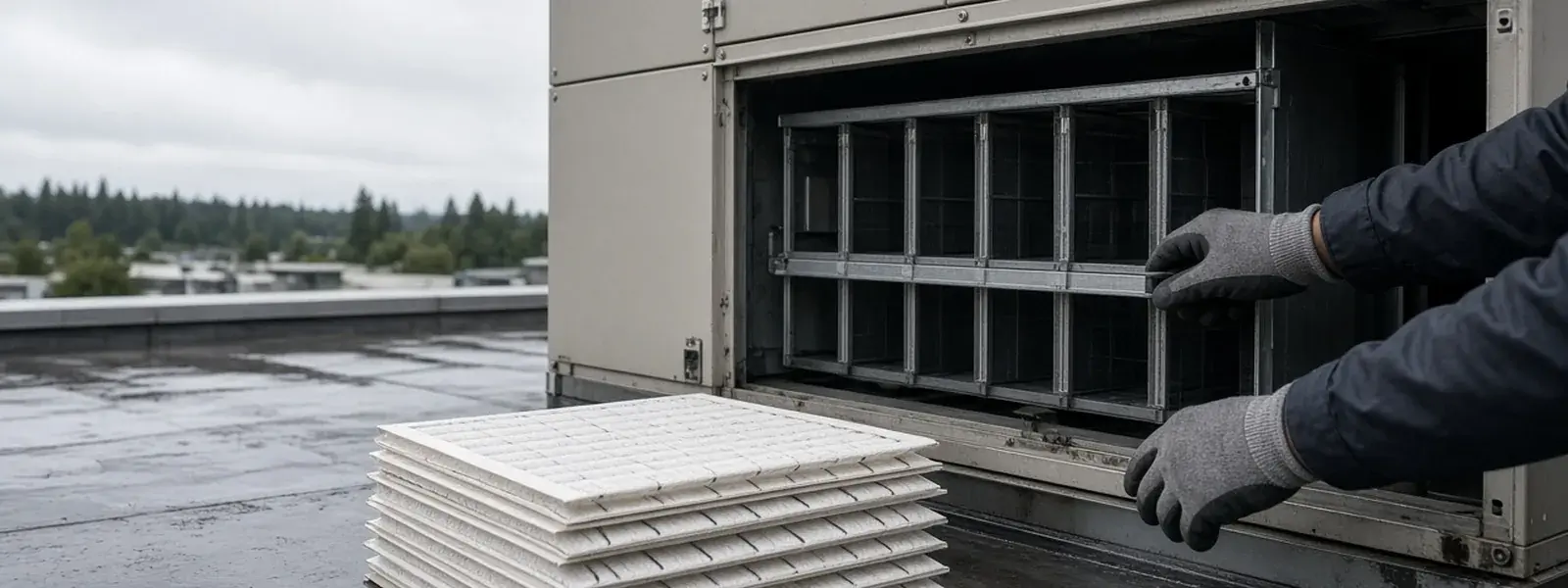
A Langley commercial system that skips maintenance fails in the wet months, not in a neat service window. Coils load with fluff, belts glaze, condensate traps dry, and outdoor-air dampers rust in place. Langley Quality Commercial HVAC runs commercial HVAC maintenance as filters, belts, coils, drains, gas heat, and a refrigerant check with numbers written down, not as a sticker on a panel. Wet Fraser Valley weather punishes neglected pans and cabinets. We treat rust and condensate as scheduled work, not as an emergency that 'came out of nowhere.'
A useful PM visit leaves a log per unit: dirty or clean, belt condition, ESP, superheat and subcooling if we're on the gauges, and any stored fault. Property managers can hand that log to ownership. A 'we were there' visit with no numbers isn't maintenance.
If you have a row of packaged units or a mix of indoor and outdoor equipment, we will work the site as a route, not as twelve surprise calls next January.
What is on the ticket
- Filter change to the rack size that's actually in the unit
- Belt inspection, tension, and pulley alignment
- Condenser and evaporator coil condition, with wash when they are loaded
- Condensate pan, trap prime, and overflow switch test
- Economizer damper stroke, sensors, and minimum outdoor-air setting
- Blower wheel cleanliness and external static pressure
- Electrical: contactors, capacitors, and visible heat marks
- Gas heat: igniter, flame sensor, inducer, and a visual on the exchanger
- Refrigerant performance: superheat, subcooling, and head pressure when the circuit can run
- Written unit log with data plate, roof location, and defects
When this call shows up
You have no written log from the last 'PM'
If nobody recorded ESP, belt condition, or a stored fault, you don't have maintenance. You have a visit. We start a real log.
Drains overflow every fall
Algae and a dry trap are seasonal on this climate. Clearing them on a schedule is cheaper than a stained ceiling and a locked-out Y circuit.
Belts are screaming by mid-season
Glazed belts and misaligned pulleys kill bearings and drop CFM. That belongs on a PM, not on a no-cool emergency.
Economizers have not been stroked in years
Dampers rust shut or open and stay there. Shoulder-season bills and winter lockouts both start here. We stroke them and set minimum OA.
A row of 15-year cabinets is about to hit another winter
A roof walk with notes on rust, exchangers, and circuits that are already weak lets you budget instead of reacting curb by curb.
How we work the job
Identify every unit and open the log
Make, model, serial, refrigerant, and roof location go on a sheet before we change a filter. Units without a tag get one.
Air path: filters, belts, coils, and ESP
We change what is in the rack, check belt and pulleys, look through the condenser, and read external static pressure. A blower off the fan table gets named.
Water path: pans, traps, and cabinet rust
Traps get primed, overflow switches get tested, and rusted pans or cabinet floors get photographed. Wet weather makes this half the PM in Langley.
Heat, cool, and economizer function
We stroke the damper, watch a heat trial if the weather allows, and take superheat and subcooling when the circuit can legally run. Stored faults get recorded even if the unit is 'fine today.'
Leave a written report, not a verbal 'looked good'
Each curb gets a condition note and a defect list. You can plan parts, a coil wash, or a replacement year from that page.
Why this shop for commercial hvac maintenance
Numbers go on the log
ESP, belt condition, and gauge readings when we take them. A sticker isn't a record.
Condensate and rust are scheduled work here
Fraser Valley moisture isn't a surprise. Pans, traps, and cabinet floors are on the PM, not only on the leak call.
Economizers get stroked, not glanced at
A damper that has not moved since the last tenant is a winter lockout waiting for a date. We move it and set minimum OA.
A roof of units is treated as a route
We can PM the whole bank on a planned visit so you are not meeting every curb as a separate emergency.
We will flag the cabinet that shouldn't get another winter of hope
Cracked exchanger signs, rusted floors, and a circuit that's already short go in writing while you still have time to plan.
The Langley detail
Commercial HVAC maintenance in Langley is mostly a fight with water and debris. The same packaged unit that looks fine in a dry September will hold a pond in the pan by November, grow a science experiment in the trap, and rust the cabinet floor from the inside. Condensate that can't leave finds a ceiling tile. A trap that dries in a shoulder-season week will slurp air and stall the drain the next time the coil runs. We prime traps, test overflow switches, and photograph rust that's past cosmetic. That's not extra. That's the climate. Property managers who only budget a spring coil wash miss the half of the year that actually kills these cabinets.
Filters and belts are boring until they are not. A 2-inch rack stuffed with a 1-inch filter, or a filter that has not been changed since the last lease, will drive external static pressure off the blower table. The coil ices or the heat exchanger overheats. Belts that are glazed or sitting on a cocked pulley do the same thing more loudly. We carry common commercial sizes, we measure ESP, and we write the reading down. If the duct is the reason ESP is high, you will see that on the log instead of buying a bigger motor that still can't move the air.
Economizer maintenance is the PM item that gets skipped and then blamed on 'the weather.' Blades pit. Actuators die. Enthalpy sensors drift and call for outdoor air when the wet bulb is useless. In this valley that means raw air on a heat exchanger or a compressor that never gets a break. We stroke the damper through its range, confirm the sensor, and set the minimum outdoor air back to what the suite needs. If the linkage is seized, that's a defect on the report, not a note we keep in our head.
Gas heat and the refrigerant circuit deserve more than a visual if the weather lets us run them. A maintenance visit in the shoulder season is a chance to watch a trial for ignition, look at the exchanger, and take superheat and subcooling before the first heat wave or the first cold snap. Stored lockouts from last season get recorded even if the unit is running today. That history is how you catch a circuit that's already leaking, or an inducer that's on its last bearing, while you can still plan the part. A PM that only changes filters is a filter change. Call it that.
Langley Quality Commercial HVAC writes commercial HVAC maintenance as a per-unit log you can keep in the property file. If you manage a plaza or a warehouse and the last report was a thumbs-up, send us the unit count and access notes. We will put filters, belts, coils, drains, damper stroke, gas-heat condition, and gauge readings on a page you can hand to ownership and actually plan from, including the cabinets that shouldn't get another wet winter of hope.
Towns we cover
Work is dispatched from Langley across the Fraser Valley. See every municipality on the where we work page.