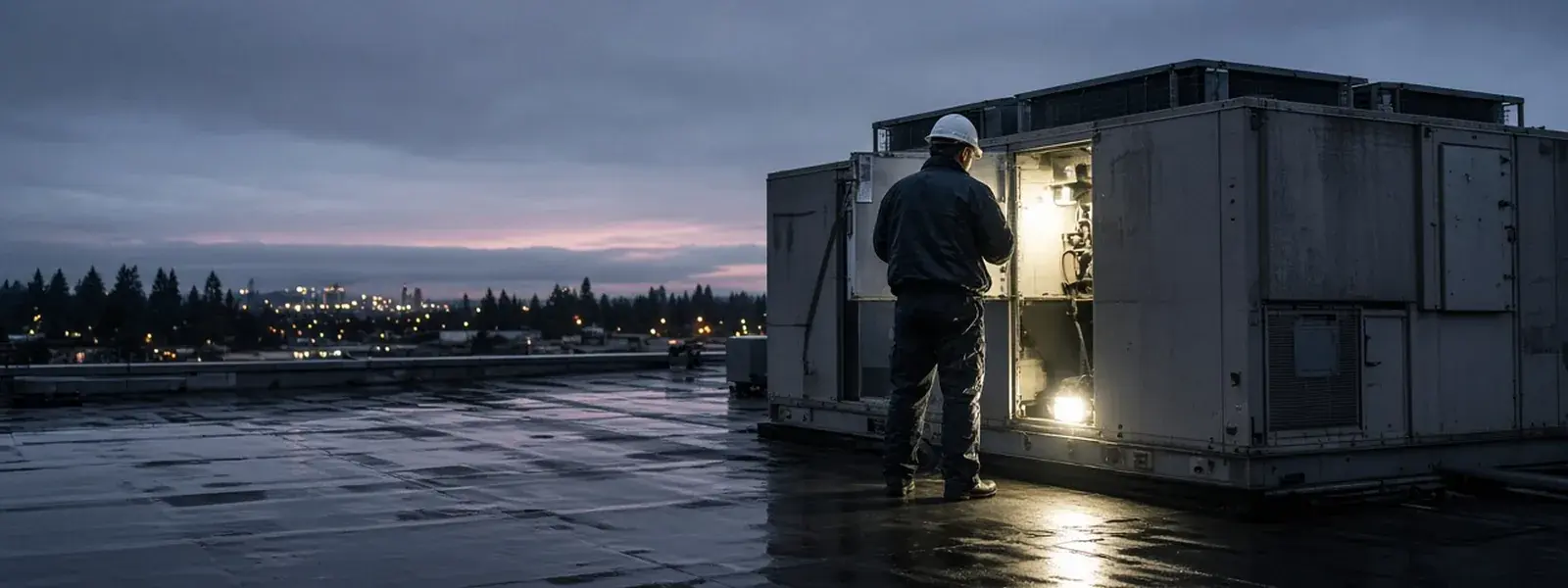
When a commercial HVAC system locks out after hours and the suite can't open, you need a tech who can tell a real fault from a reset that won't hold. Langley Quality Commercial HVAC takes emergency commercial HVAC calls for no-heat, no-cool, and lockout conditions that stop a business, including nights and weekends. We start with the disconnect, the stored fault, and whether the unit can run safely. A reset without a diagnosis is how you get a second lockout at 5 a.m. and a fried compressor.
After-hours work in Langley is often a plaza on 200 Street, a shop off the Langley Bypass, or a warehouse that can't wait for a weekday PM window. Access, keys, and who can authorize a part matter more at 11 p.m. than they do at noon. We ask those questions on the first call.
If the repair needs a compressor that's not on the truck, we will say what it takes to get the space usable and what has to wait for daylight and a parts house. We won't pretend a dead scroll is a capacitor.
What is on the ticket
- After-hours dispatch for no-heat, no-cool, and hard lockouts
- Stored fault pull and a watched call for heat or cool
- Safety circuit check: pressure, limit, rollout, overflow
- Inducer, igniter, and flame signal on a no-heat emergency
- Condenser fan, head pressure, and compressor amps on a no-cool emergency
- Economizer position if the unit is fighting itself
- Temporary run only when safeties are honest and the cabinet can fire
- Parts that are on the truck versus parts that wait for a house to open
- Roof access, hatch, and site-security coordination after dark
- Written fault, unit ID, and the follow-up that still needs to happen
When this call shows up
The suite can't open and the unit is silent or locked out
Retail, restaurants, and cold-sensitive stock don't wait for Monday. We treat a hard lockout as an emergency call, not as a voicemail.
Heat failed on a wet, cold night
Inducer prove, wet pressure-switch tubing, and flame failure are the usual after-hours heat faults. We prove draft before we keep hitting reset.
Cooling failed and product or occupancy can't wait
A dead condenser fan or a tripped high pressure can often be made honest at night. A seized scroll can't. We will say which one you have.
Water is in the suite and the unit is still trying to run
Overflow, a torn pan, or a curb leak at night still needs the circuit killed and the path found. We don't keep the blower pushing water through the building.
A BAS or occupancy schedule dumped the whole floor after a power bump
Not every dark suite is a dead compressor. We confirm the call before we start pulling contactors in the rain.
How we work the job
Get access, authority, and the symptom on the phone
Who has the hatch key, who can approve a part, and whether this is no-heat, no-cool, water, or a smell. 200 Street plazas and Bypass shops have very different after-hours security.
Make the roof safe and read the stored fault
Lock the disconnect, light the work, and pull the board history. We want the first lockout, not the one created by the last reset.
Prove whether the unit can run without lying to a safety
Inducer and flame signal on heat. Fan, head pressure, and amps on cool. Overflow and limits on both. If a safety is real, we don't jump it.
Repair what the truck can finish, and name what it can't
Capacitors, igniters, belts, sensors, and some motors go on at night. A compressor, a heat exchanger, or a custom board may not. You hear the difference on site.
Leave the space in a known state and write the follow-up
Unit ID, fault, what was done, and what still has to happen in daylight. The morning manager shouldn't have to guess why the unit is running, or why it isn't.
Why this shop for emergency commercial hvac
We won't jump a real safety to 'get you open'
A rolled-out heat exchanger or a high-pressure trip that keeps coming back is information. Bypassing it is how cabinets fail hard.
After-hours access is planned on the call
Hatch keys, alarms, and who meets us on 200 Street or the Bypass get sorted before the truck rolls. Standing in a lot at midnight without a key helps no one.
You get an honest split between truck parts and daylight parts
We won't sell a night compressor story if the fault is a fan. We also won't pretend a dead scroll is finished because the board was reset.
The morning file matches the night work
Fault, unit ID, and follow-up go in writing. Property managers can pick it up without a scavenger hunt.
Emergency is for buildings that can't wait, not for every noise
If it can be a morning diagnostic, we will say so. If the suite can't open, we treat it that way.
The Langley detail
After-hours commercial HVAC in Langley is a geography problem as much as a mechanical one. A plaza along 200 Street may have a shared hatch, a security company, and six tenants who all think their own suite is the only one that matters. A shop off the Langley Bypass may have a yard gate, a dog, and a rooftop ladder that nobody mentioned. We want access and authority on the phone before the truck is moving. The mechanical work is the same inducer, the same high-pressure switch, the same overflow float. The lost hour is always the locked hatch or the person who can't approve a part. Ask your night manager who holds the keys before you need them.
The most common night heat call is a lockout after a wet wind. The inducer ran, the pressure switch did not stay closed, and the board stored flame fail. Someone already hit reset once. The honest job is to find the wet hose, the cracked inducer housing, or the igniter that opened, then watch a complete trial for ignition. The most common night cool call is a condenser fan that died and took the circuit out on high head. Spinning the fan by hand, checking the capacitor, and reading head pressure tells you if the suite can have cooling again or if the scroll has already cooked. Resetting a high-pressure lockout without a live fan is how you buy a compressor after hours that still won't run.
There is a line we won't cross on an emergency. We won't jump a rollout, a limit, or a pressure switch to get a door open. We won't keep firing a heat exchanger that shows flame where it shouldn't. We won't leave a unit in a state the morning staff can't explain. If the repair needs a compressor, a heat exchanger, or a board that's not on the truck, we will say what, if anything, can be done to keep pipes from freezing or stock from cooking, and what has to wait. Portable heat or a temporary hold is a conversation about safety, not a promise that the rooftop is fixed.
Follow-up is part of emergency work. A night capacitor or igniter that gets the suite open still belongs on a ticket with the data plate and a note to watch that circuit. A wet trap that overflowed at 10 p.m. still needs a real drain repair. Property managers who treat every after-hours reset as the end of the story meet the same curb again. We write the follow-up while we're still on the roof, in the light we brought, so the morning call is a plan and not a mystery. If the rest of the row looks like it will be next, that goes on the same page.
Langley Quality Commercial HVAC takes emergency commercial HVAC calls when a building can't wait for a weekday window. If a unit is locked out on 200 Street, the Bypass, or anywhere we cover, call the number on this site, have the access notes ready, and tell us whether this is heat, cool, water, or a smell. We will tell you if we can make the cabinet honest at night, and what still has to happen when the parts house opens.
Towns we cover
Work is dispatched from Langley across the Fraser Valley. See every municipality on the where we work page.