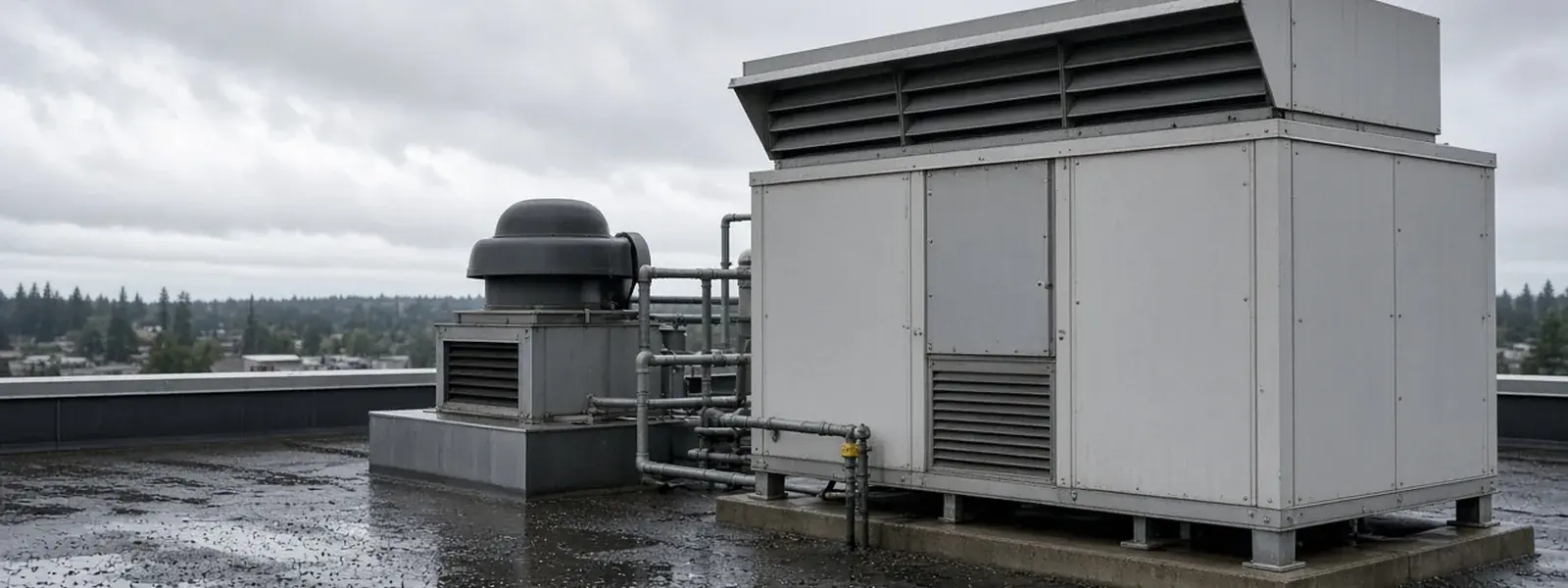
Kitchen exhaust without matched make-up air pulls smoke into the dining room, slams doors, and trips the hood. Langley Quality Commercial HVAC repairs and installs make-up air units so the CFM leaving through the exhaust is replaced with tempered outdoor air, not with air stolen from the suite next door. A restaurant on a plaza curb, a shop with process exhaust, or a warehouse weld bay needs an MUA that can light, prove, and discharge at the right temperature. We size from the exhaust, not from the leftover rooftop that happened to be vacant.
ASHRAE 62.1 thinking still applies. Outdoor air isn't optional because the cook line is loud. Direct-fired and indirect-fired cabinets each have a gas train, a profile plate, and a discharge sensor that have to work together.
If the hood already exists and the building never got an MUA, that's the usual Langley call. We measure exhaust, look at the roof opening, and tell you what cabinet belongs there.
What is on the ticket
- Exhaust CFM measure and MUA supply match
- Direct-fired or indirect-fired cabinet selection
- Gas train: valve, regulator, manifold, and flame supervision
- Burner, profile plates, and discharge-air sensor
- Interlock with the hood or process exhaust starter
- Outdoor-air intake, bird screen, and freeze / low-limit
- Technical Safety BC gas path on valve and pipe work
- Duct discharge into the kitchen or shop without short-circuiting the hood
- Controls: enable, discharge setpoint, and occupancy or hood switch
- Startup: manifold pressure, flame signal, discharge temperature, and supply CFM
When this call shows up
The hood smokes the dining room when it ramps up
Exhaust is winning. Doors slam and odour migrates. That's missing or undersized make-up air, not a 'stronger fan' problem.
The MUA won't light or it locks out on flame fail
Dirty burner, weak flame signal, a pressure switch, or a gas train that won't open. We prove the sequence before we order a valve.
Discharge air is ice-cold or wildly hot
A failed discharge sensor, a stuck modulating valve, or profile plates that were never set will dump raw air or overfire the space.
A new kitchen is going into a plaza suite
The existing packaged RTU isn't a make-up air unit. Exhaust and MUA have to be sized together before the hood is commissioned.
Process exhaust in a shop has no dedicated supply
Weld, paint, or dust exhaust will steal building air and fight the rooftop units. A dedicated MUA keeps the RTUs from becoming accidental make-up.
How we work the job
Measure the exhaust before we talk about a cabinet
Hood or process CFM is the design number. We don't guess from the old MUA nameplate if the line has changed, and we don't undersize to fit a pretty curb.
Pick direct-fired or indirect and lay out the gas train
Direct-fired is common for large outdoor-air loads. Indirect keeps combustion separate. Either way the valve, regulator, and flame supervision have to match the burner and Technical Safety BC practice.
Set profile plates and the discharge sensor
Velocity across the burner and the discharge-air setpoint decide whether the unit can temper Fraser Valley winter air without overfiring. This is setup, not trim.
Interlock the MUA with the exhaust
The make-up unit shouldn't sit silent while the hood runs, and it shouldn't fire into a dead exhaust. We wire the enable to the starter or the hood control.
Commission CFM, flame, and discharge temperature
Supply air gets measured, manifold pressure gets recorded, and discharge temperature is watched through a cold start. You get those numbers with the data plate.
Why this shop for make-up air units
We size MUA from exhaust CFM
A leftover 2,000 CFM cabinet on a 4,000 CFM hood is a smoke complaint. The hood wins until the numbers match.
Gas trains are treated as gasfitting
Valves, regulators, and flame supervision sit under Technical Safety BC rules. We don't treat a rooftop burner like a barbecue.
Interlock is part of the install, not a later wish
If the hood can run without make-up air, it will, and the dining room will pay for it.
Discharge temperature is a measured setting
Raw outdoor air on a wet January line is how you freeze staff and trip other units. We set and record it.
Plaza kitchens are a known Langley pattern
A suite that used to be retail now has a hood. We have that conversation early so the packaged RTU isn't asked to be an MUA.
The Langley detail
Make-up air on a Langley restaurant roof is a different machine from the packaged RTU that heats the dining room. The MUA's job is to replace the CFM the hood is throwing away, and to temper that outdoor air so the line doesn't sit in raw valley weather. When the MUA is missing or short, the hood pulls from the dining room, the vestibule, and eventually from the suite next door. Doors get hard to open. Smell shows up in the hallway. The packaged unit starts looking guilty because it can't keep up with a building that's under negative pressure. We measure exhaust first. Then we talk about a cabinet. Adding a bigger dining-room rooftop never fixes a hood that has no make-up.
Direct-fired MUAs are common because they can handle large outdoor-air loads without a giant heat exchanger. Combustion happens in the airstream, which means profile plates, velocity, and flame supervision are not optional trivia. Too little velocity and the burner doesn't stay clean. Too much and you can't light. Indirect-fired cabinets keep combustion separate and add a heat exchanger and a flue, which changes the gas train and the service path. Either style has a discharge-air sensor that has to be in the real leaving air, not taped to a cabinet wall. We set plates, we watch flame signal, and we record manifold pressure. A unit that 'runs' but can't hold discharge temperature isn't commissioned.
ASHRAE 62.1 is the outdoor-air conversation people skip when they are only thinking about the hood. The kitchen needs the exhaust matched. The dining room still needs ventilation air that's not whatever leaked under the front door. On a plaza, that often means the packaged RTU keeps its economizer at a real minimum while the MUA handles the hood. We don't steal the RTU's outdoor air to make up a 3,000 CFM line. We also don't dump MUA into the hood canopy so the supply short-circuits and never reaches the room. Discharge location is a design choice. Putting it ten feet from the filter bank is how you pay for CFM you never feel.
Service calls on existing MUAs in Langley are usually light, lockout, or wild discharge. Wet weather loads flame rods and pressure switches the same way it does on a rooftop furnace. A modulating gas valve that has drifted will overshoot and trip high limit, or undershoot and blow cold. Filters on the outdoor-air intake load with cottonwood and then the profile velocity falls off. We clean, we prove the sequence from enable to flame to discharge, and we check the interlock. If the hood contractor bypassed the MUA so the kitchen could open, we will say that on the ticket. The building will keep smoking until that wire is honest.
Langley Quality Commercial HVAC sizes and services make-up air units as exhaust-matched equipment, not as a leftover rooftop sitting on a vacant curb. If a kitchen or a process bay is pulling the building negative, send the hood CFM if you have it, a photo of the roof opening, and how the exhaust is started. We will tell you what MUA belongs there, whether direct-fired or indirect fits, and whether the gas train and hood interlock are even in the race.
Towns we cover
Work is dispatched from Langley across the Fraser Valley. See every municipality on the where we work page.