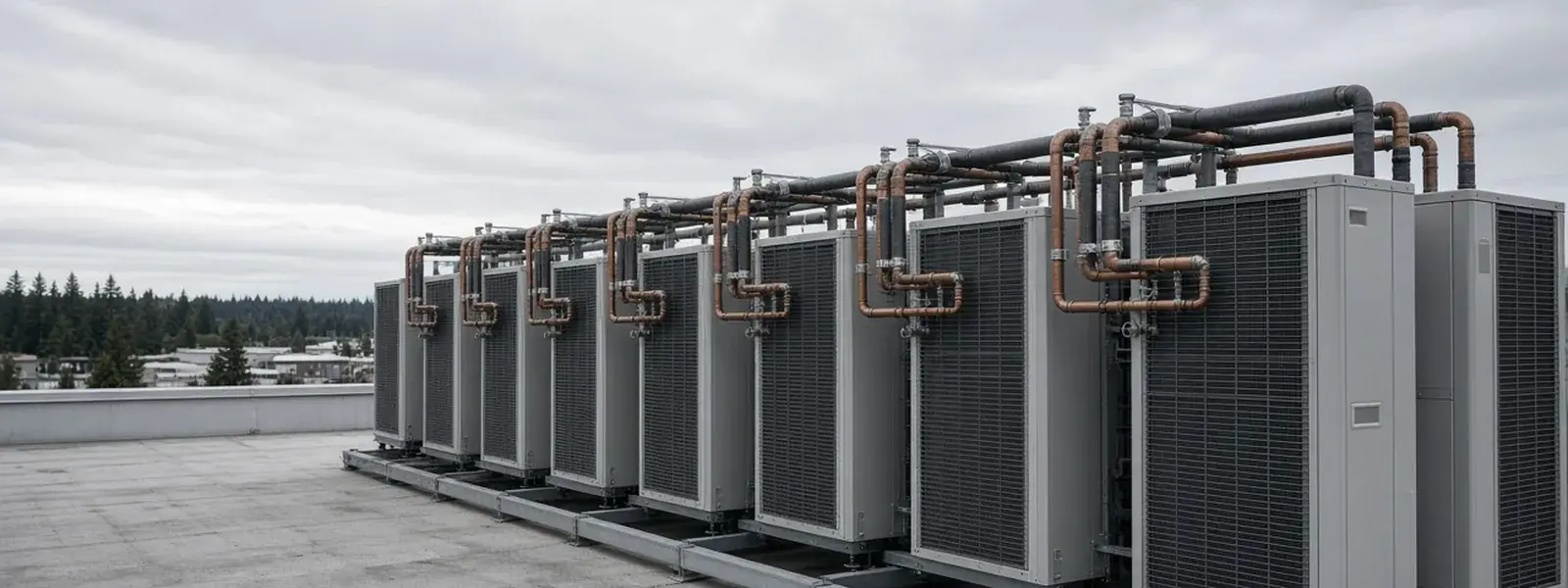
A VRF or VRV system that loses a zone, throws an inverter fault, or can't shift into heat recovery isn't a packaged rooftop problem. It is a communicating refrigerant network. Langley Quality Commercial HVAC diagnoses variable refrigerant flow on office and mixed-use buildings by reading inverter codes, branch-box behaviour, and actual superheat at the indoor coil, not by resetting the central controller until the next drop. Downtown City of Langley offices and newer Willowbrook-area commercial suites often sit on heat-recovery VRF with a condenser bank on the roof or a side yard. One leaking joint can take a whole branch offline.
These systems use EEVs, branch selectors, and a communication bus. A failed indoor fan looks like a refrigerant fault until you read the address. We start at the controller history, then we go to the outdoor inverter and the branch box.
If you have a leak, we nitrogen-test and find it. We don't keep charging a heat-recovery loop and hoping the next stain is obvious.
What is on the ticket
- Central controller and indoor-unit address verification
- Inverter fault history, DC bus, and outdoor fan module checks
- Branch selector or branch-box valve operation on heat-recovery systems
- EEV operation and indoor coil superheat or leaving-air temperature
- Communication bus integrity, shielding, and polarity
- Leak search: nitrogen hold, sniffer, and joint-by-joint on the line set
- Oil return and piping rules against the manufacturer’s limits
- Defrost, mode conflict, and simultaneous heat-cool behaviour
- Condenser clearances, coil cleanliness, and module amp draw
- Recovery, weigh-in, and charge to the factory length correction
When this call shows up
One office is dead and the rest of the floor is fine
That's often an indoor address, an EEV, or a branch-box port, not a failed outdoor unit. We read the controller before we condemn the inverter.
The outdoor unit is in inverter fault or overcurrent
A shorted module, a locked fan, or a system that has been run low on charge will take the inverter down. Codes plus DC bus readings come first.
Some rooms heat while others blow lukewarm in shoulder season
Heat-recovery VRF should move energy between zones. A stuck branch selector or a mode conflict on the controller will leave half the floor unhappy.
You can hear the indoor unit but the air isn't changing temperature
Fan without capacity is an EEV, a strainer, or a charge problem. Leaving-air temperature and the coil tell us which.
Oil spots or oil dust on a branch-box joint
That's a leak path until proven otherwise. We hold nitrogen and find it. Topping the charge on a VRF loop is a short story.
How we work the job
Pull the controller history and map the addresses
We want the first fault, the indoor that dropped, and whether the outdoor inverter, a branch box, or a single fan coil is in the complaint. Guessing from the warm room wastes a day.
Read the outdoor inverter and the refrigerant picture
Fault codes, module temperatures, and fan amps sit next to discharge, suction, and subcooling at the outdoor coil. Low charge and a failed inverter can look similar until you have both.
Check branch selectors and EEVs on the affected path
Heat-recovery systems live and die at the branch box. A port that won't shift, or an indoor EEV that won't open, isolates a zone without killing the plant.
Prove or disprove a leak before we talk about charge
Nitrogen hold on the isolated section, sniffer on joints, and a look at factory fittings on the branch box. Charge is weighed to pipe length only after the loop is tight.
Restore communication and confirm mode behaviour
Bus polarity, shields, and addressing get fixed if that was the fault. Then we watch heat, cool, and simultaneous operation on a heat-recovery system so the floor actually does what the controller claims.
Why this shop for vrf / vrv systems
VRF is a network, not a split with extra copper
Addresses, EEVs, and branch boxes come before a 'add gas' visit. We treat it that way.
We isolate the zone before we condemn the outdoor bank
One dead office is usually an indoor or a port. The inverter gets blamed too early on these jobs.
Leak finding is a hold test, not a smell test
Oil dust is a clue. Nitrogen and time are the proof. We won't keep filling a heat-recovery loop.
City offices and mixed-use suites are a known VRF pattern here
Downtown City of Langley and newer commercial floors around Willowbrook use these systems. We come with the controller software and the gauges, not only a rooftop bag.
Charge is weighed to line length
Factory correction for pipe isn't a guess. After a leak repair we weigh, we don't 'see how it feels.'
The Langley detail
VRF in Langley shows up where a packaged rooftop would have been a blunt tool: multi-tenant offices in the City of Langley, boutique commercial on a tight lot, and mixed-use floors that want heat in the north rooms while the south glass still needs cool. Heat-recovery systems do that through branch selector boxes. Heat-pump VRF can't. If someone sold a heat-pump plant into a building that needs simultaneous modes, no amount of controller resetting will make the floor happy. We start by identifying which plant you actually have, how the indoor units are addressed, and whether the complaint is one coil, one branch, or the outdoor inverter. That map is the job. Without it you are swapping boards in the dark.
Inverter faults get treated like a death sentence and they are often a symptom. A system that has been leaking will run the compressor out of its envelope, raise discharge, and trip the module. A condenser coil packed with cottonwood will do the same thing with high head. A fan module that has seized takes current the inverter doesn't want to give. We read the code, we look at the coil and the fans, and we look at the refrigerant picture. Replacing an inverter on a low-charge plant is a good way to replace it twice. The outdoor bank is expensive. The diagnosis has to be cheaper than the guess.
Indoor units fail in quieter ways. An EEV that won't open leaves a coil at room temperature with a fan that sounds healthy. A strainer at the indoor or the branch box will starve a zone after a sloppy repair introduced debris. Communication errors from a pinched bus or a reversed shield will drop a whole group and look like a refrigerant outage. We check leaving-air temperature, coil condition, and the address against the controller. If the indoor is the fault, the outdoor plant should stay closed. Opening the whole system to change a fan coil without isolation valves is how you turn a zone repair into a building recovery.
Piping rules are not suggestions on these systems. Oil return, elevation, and total line length have limits. A tenant improvement that added three indoor units onto a branch that was already long will oil-log and throw random inverter codes. We compare the as-built to the manufacturer’s limits when the faults won't stay gone. Leak repairs get a nitrogen hold, not a quick sniff and a shrug. Joints at branch boxes and factory flare or braze points are the usual Langley leak sites, especially where a ceiling grid has been moved a few times. When we recharge, we weigh to the factory charge plus the line-length correction. A 'bit more for luck' is how you flood a VRF and buy another inverter.
Langley Quality Commercial HVAC works VRF and VRV as inverter, branch, and charge work, not as a rooftop with extra indoor units taped on. If an office floor has a dead zone, an inverter fault, or oil at a branch box, send the controller alarm list and how we get to the outdoor bank. We will tell you whether this is an address, a branch-box port, a leak that needs a nitrogen hold, or a module that's actually finished, and we will weigh any recharge to the factory length correction.
Towns we cover
Work is dispatched from Langley across the Fraser Valley. See every municipality on the where we work page.